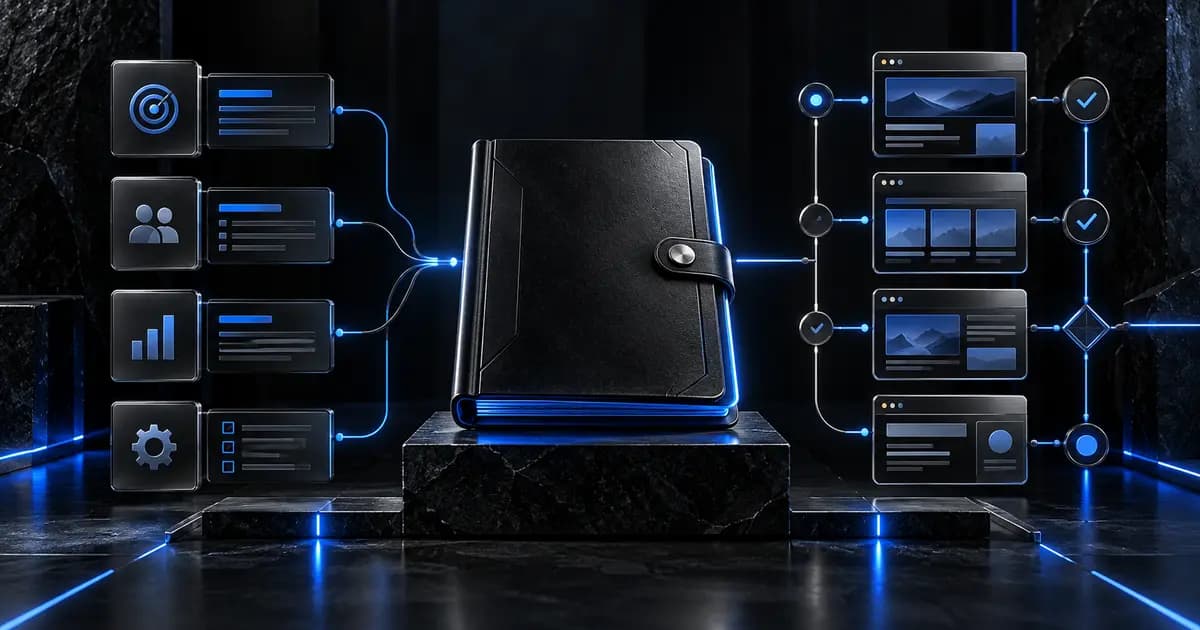
In short: an MVP is the smallest version of a product capable of verifying a hypothesis of use in credible conditions. It reduces the scope, not the requirement on the critical journey, data security or the ability to learn.
An application idea often comes in the form of a list of functions: accounts, dashboard, messaging, payments, notifications, exports. This list describes a solution imagined, but not yet the problem to be solved. The scoping must return to a concrete situation and to a specific user.
A good MVP answers three questions: who encounters the problem, what essential action should become possible, and what observation will allow us to decide what to do next?
Formulate a verifiable hypothesis
"Creating an innovative platform" is not a hypothesis. A usable formulation links a group of users, a difficulty, a proposal and a signal: for example, managers must be able to centralize a request and track its processing without copying the same data.
This formulation fixes the center of the product. Functions that do not contribute to the test can wait, even if they would be pleasant in a mature version.
Observe the current process
Before drawing the application, map how the work is done today: tools, spreadsheets, emails, validations, double entries and exceptions. Identify the information produced, the people responsible and when a decision is made.
The future product must simplify this process without removing useful safeguards. Automation that accelerates the nominal case but makes exceptions impossible to handle shifts complexity instead of reducing it.
Choose a critical path
The MVP can have multiple screens, but it must have a complete main course. For a customer portal, this journey could be: receive access, consult an element, perform an action, obtain confirmation and find history.
Building a half of ten functions brings less learning than an essential scenario that can be used from start to finish. Secondary journeys are documented in a backlog with the reason for their postponement.
Define roles and data from the beginning
Who can see, create, modify, approve or delete each data? The roles are not limited to "admin" and "user". A manager, an operator and a customer may have separate needs.
The data model describes the entities, relationships, statutes and retention rules. It also predicts errors: duplicate, deleted item, expired invitation, unavailable third-party service. These decisions avoid dispersing contradictory rules on the screens.
Prototype before developing
A clickable prototype allows you to test the vocabulary, the order of the steps and the understanding of the actions. He doesn't need to imitate each final animation. It must make the route visible and allow a representative user to explain what he thinks he can do.
Start with the mobile if the use is nomadic or if the product should work everywhere. The wide versions then use the available space without transforming each piece of information into a massive block.
Reduce the scope with explicit criteria
For each function, ask four questions:
-
is it essential to the critical journey?
-
is it necessary to protect data or respect a constraint?
-
does it make it possible to measure the hypothesis?
-
does its absence really prevent pilot use?
A feature may be important and nevertheless planned for the next version. Transparency on this cutting protects the budget and facilitates the acceptance testing.
Choose an architecture that allows the product to evolve
The MVP does not justify a disproportionate infrastructure. However, it must properly separate the interface, server rules, authentication and data. Secrets remain on the server side, access is limited and critical operations are traced.
The choice between managed service, relational base, API or more integrated solution depends on the level of control, the skills available and the expected operation. Our web and mobile application development service details this proportionate approach.
Integrate security and confidentiality into the critical journey
Even a driver must validate entries, protect accounts, and prevent one user from accessing another's data. Environments are separate, logs contain no secrets and backups are planned according to the value of the information.
If personal data is processed, document the purpose, authorized persons, retention period and mechanisms for exercising rights. Do not collect information "just in case".
Measure useful behavior
Metrics must allow a product decision. A registration does not prove that the application solves the problem. Instead, observe the completion of the journey, the time required, abandonments, errors and qualitative feedback.
Define before the pilot what will lead to pursuing, modifying or stopping a hypothesis. The result can be negative without the MVP being a failure: learning early that a proposal does not work avoids a much larger investment.
Organize a controlled pilot
A small representative group allows you to observe the uses with direct support. Prepare accounts, sample data, instructions, return channel and incident procedure. Distinguish between comprehension problems, technical defects and comfort requests.
The acceptance testing covers the nominal path, errors and permissions. Automated tests secure the essential rules; manual tests verify the actual behavior on mobile, desktop, keyboard and less favorable network.
Decide on the post-MVP
At the end of the pilot, summarize the facts: observed uses, blocking steps, operating costs, risks and recurring requests. The backlog is reordered according to this subject, not according to the initial list.
The following version can deepen the journey, add integration or improve administration. It may also require a targeted redesign of a provisional choice. This debt is acceptable if it has been identified and if the MVP has allowed a decision that the prototype alone could not provide.
To connect product, UX, architecture and deployment, also consult our guide on the steps of a web project and our approach to business automation. You can present us your application idea with the problem, users and path you want to check.